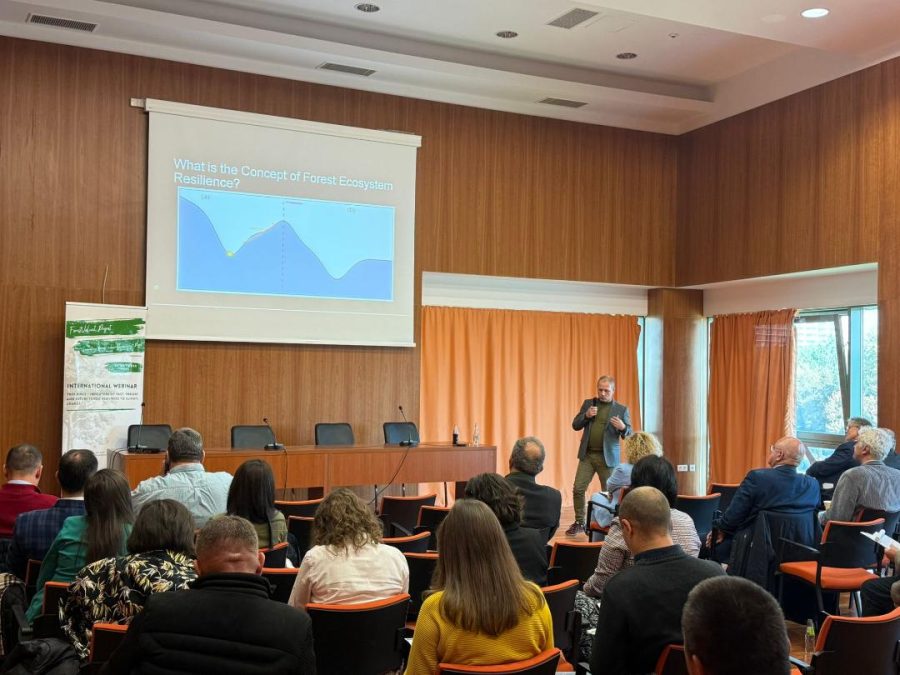
International seminar took palce in Bucharest, 22nd of October, 2025 as part of ForestValue2 project, and was organised under WP 6 – Others joint activities, under Task 6.1 (Series of outreach webinars with high profile guest speakers/panellists). The event was held in a hybrid format, both online and in person with 45 participants attending on site and 20 joining online.
Two distinguished speakers were invited, each presenting on their specialized areas of expertise:
- Michal Bosela, Associate Professor and Senior Scientist at the Technical University in Zvolen, National Forest Centre, Slovakia, who delivered the presentation “Quantifying and modelling forest resilience: Concepts, indices, and modern approaches”.
- Ionel Popa, Senior Scientist at the “Marin Drăcea” National Institute for Research and Development in Forestry, Romania, who delivered the presentation ”Beyond linearity: decoding space-time complexity in tree ring climatic signal”.
The aim of the international webinar “Tree rings – Indicators of past, present and future forest resilience to climate change” was to advance understanding of how tree-ring data can be used to assess and model forest resilience to climate variability and change and to promote climate-smart forestry approaches.
Specifically, the webinar sought to:
- present state-of-the-art concepts, indices and methodologies for quantifying forest resilience using tree-ring–based proxies;
- highlight the limitations of traditional linear dendroclimatic approaches in capturing non-linear, threshold and legacy effects of climate stress.
- showcase innovative statistical, machine-learning and process-based modelling approaches that improve interpretation, prediction and mechanistic understanding of climate-growth relationships.
- foster scientific exchange and interdisciplinary discussion among researchers, practitioners and policymakers on integrating multiple modelling frameworks for better assessment of forest responses to climate change.
Scientific Context and Key Messages
Forest ecosystems are affected, with increasing frequency and intensity, by climate-driven stressors such as drought, heat waves, and extreme events, threatening their capacity to maintain growth, carbon sequestration, and ecosystem services. Understanding forest resilience and tree growth responses to climate variability is mandatory for the implementation of climate-smart forestry.
Tree-ring data offer a unique, annually resolved archive of climate–growth interactions, extending beyond traditional ring-width measurements to include wood density, isotopic composition, chemical signals, and anatomical traits. These proxies reflect different physiological processes and respond to climate at multiple temporal scales. Climate influences tree growth directly through photosynthesis and cambial activity and often induce non-linear responses and legacy effects that challenge classical linear dendroclimatic approaches.
Forest resilience is commonly evaluated through resistance, recovery, and overall resilience indices, quantified using growth-based indices derived from tree-ring or basal area increment data. Resilience indices are useful to compare species, sites, and regions, but their interpretation is sensitive to extreme event definition, timing of climatic events, species-specific phenology, and the choice of growth proxy. Consequently, resilience indices alone are insufficient to fully capture forest responses to climate change and new modelling approaches are needed.
Presentations and the debates during the webinar emphasized the need for a methodological shift from linear models toward flexible statistical and machine-learning approaches, such as Generalized Additive (Mixed) Models and Random Forests, which better capture non-linearity, interactions, and thresholds in climate–growth relationships. At the same time, process-based models provide mechanistic insight into tree physiology and wood formation, enabling stronger causal interpretation. An integrated modelling strategy that combines resilience indices for baseline comparison, statistical models for inference, machine learning for prediction, and process-based models for understanding the physiological mechanisms is essential for climate-smart forestry.
Scaling from individual trees to stands and regions, and linking empirical observations with continuous monitoring, is critical for translating scientific understanding into adaptive forest management under climate change. Policy frameworks must move beyond average growth trends and explicitly address resilience, vulnerability, and non-linear climate impacts.
Key Evidence Highlighted
- Tree growth and forest resilience exhibit non-linear and threshold responses to climate stress.
- Resilience indices are useful but method-dependent and should be integrated with modelling approaches to improve both understanding and prediction of climate change impacts.
- Long-term, multi-scale data are essential for robust decision-making.